Based on an extremely informal–and limited–survey among my family and friends, the story of the Amistad is vaguely familiar to many, but few know the details. This was certainly the case for me when I happened upon the Amistad Center for Art and Culture, an independent non-profit that’s housed in the Wadsworth Atheneum Museum of Art in Hartford, Connecticut. The collection includes over 7,000 works of art, artifacts, and archival materials covering over 300 years of Black American history, which it draws on for exhibitions at the Wadsworth. The scale model of The Schooner, Amistad included just enough information to whet my appetite to learn more.
To make a long (over two years) story short, La Amistad was a schooner transporting 53 Mende captives in 1839 from Havana, Cuba to a sugar plantation elsewhere on the island. The Mende had been kidnapped from what is now Sierra Leone and illegally brought to Cuba as slaves. One of them, Sengbe Pieh (given the American name of Joseph Cinqué), was able to free himself from his shackles and release the rest of the Africans. Using sugar cane knives, they took over the ship, killing the captain and cook. They forced the remaining crew to sail back to Africa, but the crew steered the ship east by day and back to the west at night, hoping to be seen and rescued by Americans.
After almost two months, the ship was captured off the coast of Connecticut, and a complicated legal procedure began. The Mende captives had committed mutiny, but the international slave trade had been illegal for more than 30 years. The case went all the way to the Supreme Court where former President John Quincy Adams defended the Mende. They won their case and were free to return to their homes. Abolitionists in Farmington, Connecticut offered them a place to live for several months, when enough money had been raised to finance their return trip, and 35 survivors were able to return to their homes in Africa.
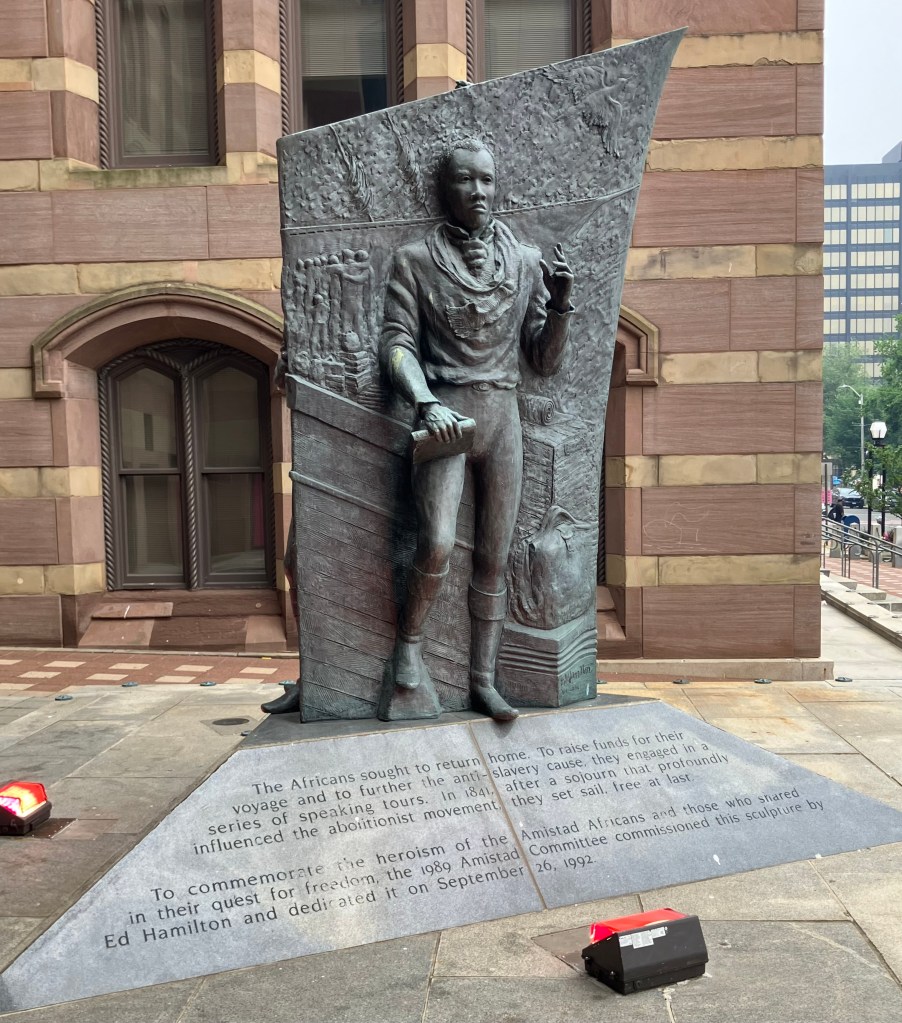
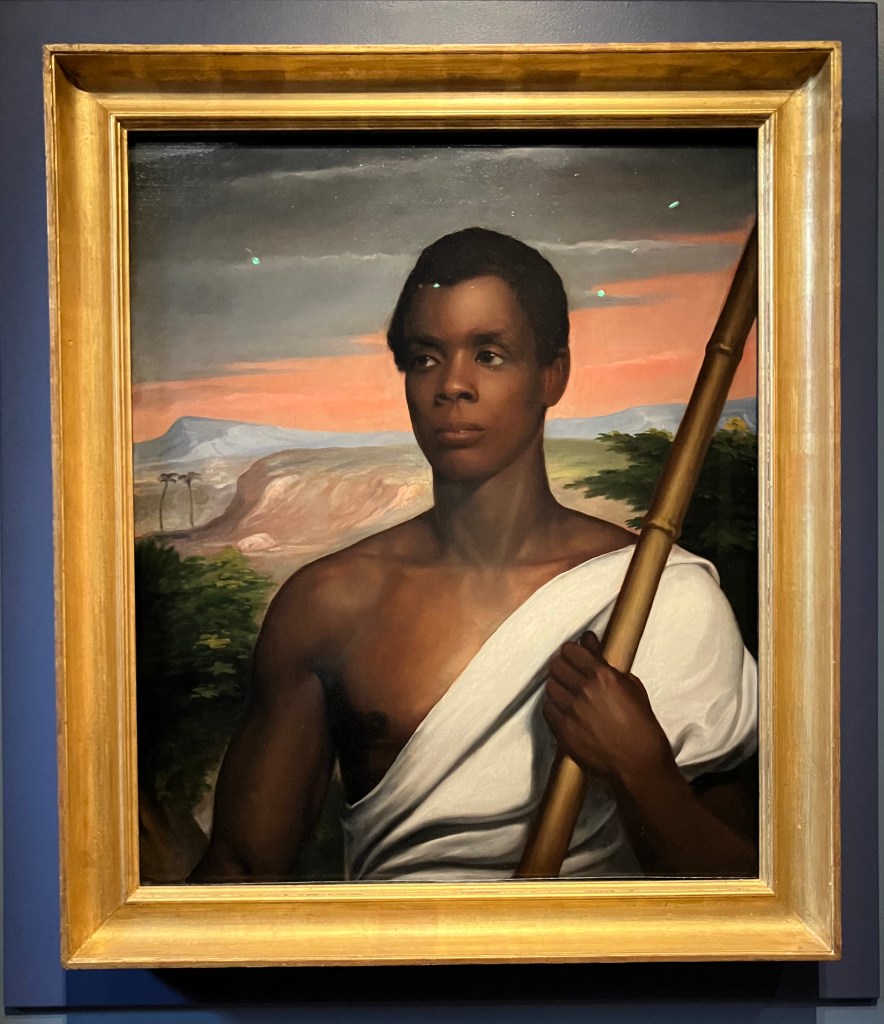
You can visit the towns in Connecticut that were the settings for these events to learn more. In New Haven, where the Mende captives were imprisoned and tried, the New Haven Museum has an exhibit called Amistad: Retold, which is a good place to get an introduction to the story. There’s also an Amistad memorial in front of the New Haven City Hall with images of Joseph Cinqué.
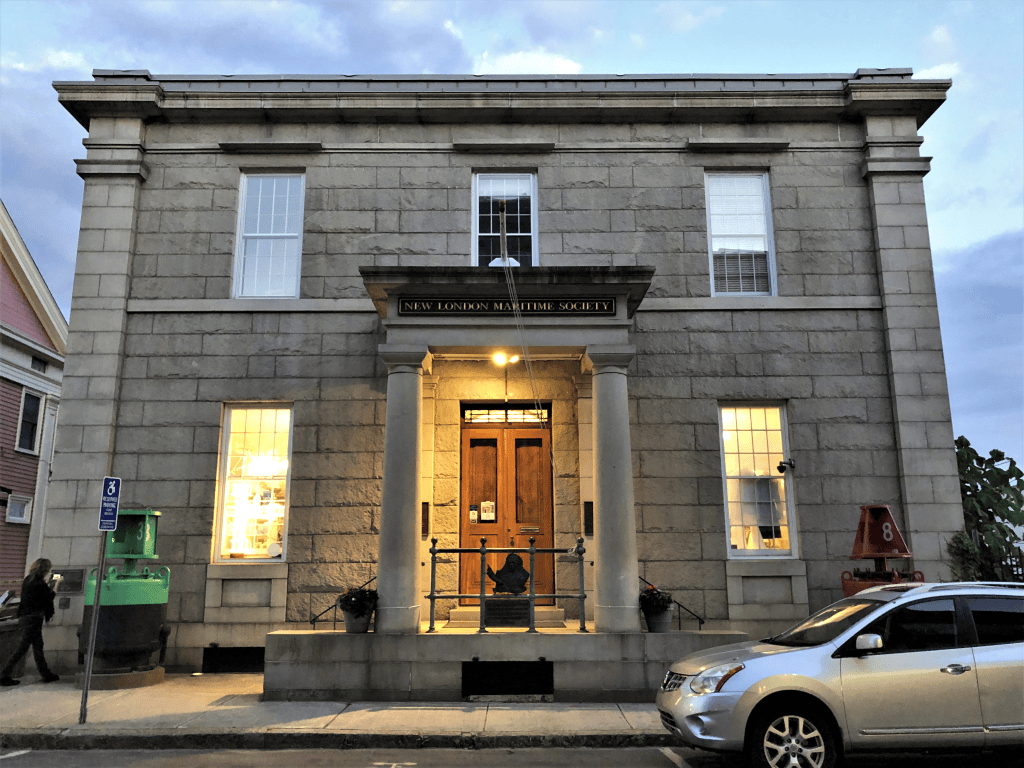
The Custom House Maritime Museum in New London, where La Amistad was towed after it was captured off the coast of Long Island, also has an exhibit. The staff suggested a guided tour, which I opted out of, but I think they were right to recommend it. There are fairly lengthy labels telling the story as you walk around the room, but there are also cases of artifacts with no labels, and the whole exhibit felt like kind of a jumble. If you went without much prior knowledge of the event, it would be especially confusing.
The Farmington Historical Society offers its “Odyssey of the Amistad” walking tour many Saturdays in the summer and fall. The tour starts at the First Church of Christ, Congregational with a 30-minute presentation featuring costumed interpreters that tells the story of the Amistad. From there, guides walk visitors through town showing them key locations in Farmington’s role in the story.

Finally, Discovering Amistad is an educational organization based in New Haven. As of this writing, the Amistad replica used for many of their programs is undergoing renovations and not open to the public, but they continue to participate in other educational initiatives.
As I read some of the books about this case, I started to see some difficulties in telling the story. To start, the Mende are the central characters, but they spoke a different language and came from a very different culture than the Americans who create and consume these works. Not only that, but our values have changed from those of 19th-century abolitionists. Their efforts to convert the Mende to Christianity is an uncomfortable truth that has to be reckoned with in any retelling.

I’ll admit this led to me feeling a bit uneasy reading one of the children’s books I found about this case, Africa Is My Home: A Child of the Amistad by Monica Edinger, illustrated by Robert Byrd (Candlewick, 2013, 64 pages, grades 3-7). The narrator of this fictionalized account of the Amistad is a girl named Magulu, whose name is changed in America to Margru, and who eventually takes the name Sarah Kinson. She was 9 years old when she was sold into slavery and began her journey to America. In America, Margru went to school and converted to Christianity, leading her to become a teacher at a mission school in Sierra Leone.
Margru’s heartfelt embrace of Christianity felt uncomfortable to me, even if it is historically accurate, and I wish the author had addressed that in her author’s note. It would have been interesting to elaborate on the religious beliefs that many abolitionists shared and proselytized to the Africans, believing they were doing the right thing, and how ideas about the superiority of one religion or culture over another have changed over time.

A different perspective is offered in The Black Schooner: Rebellion on the Amistad by David Lester and Marcus Rediker with Paul Buhle (Beacon Press, 2026, 136 pages, grades 6 and up). This graphic novel tells the story of the Amistad in three parts: Rebellion, Trials, and Freedom. Although there are different points of view, the book centers the Mende people as the main characters. Readers learn more about the Mende people’s lives before these events and how their previous work, beliefs, and culture influenced them as they went through the trials. I also appreciated how the American abolitionists who helped them were seen as the woke, far-left people of the day but now appear to have been very much on the right side of history.
I particularly like the foreword by Marcus Rediker, “Why We Need Stories of Successful Resistance.” He writes how the Mende and the American abolitionists had a “working misunderstanding” which allowed them to cooperate and ultimately be successful despite their different perspectives. What was true almost two centuries ago is still true today, as Rediker concludes, “The Africans who rose up to free themselves in 1839 showed that profound injustice could be brought to an end by human means, which is an important lesson for our own times.”


